



Simulation
- The Simulation of Reality
- Our World is Energy
- Illusion of Matter
- Matter as a Play of Light
- Perceptible Energy
- Stage of Consciousness
- Dreams
- Duality
- Near-Death
- Reincarnation
- Visible – Invisible
- Subjective – Objective
- Feel the Journey
The Simulation of Reality
Have you ever wondered what we – and the world around us – are actually made of?
Our World is Energy
Physics, the natural science that deals with the fundamental properties of matter, energy, space, and time, shows that everything we perceive as solid or material is, at its core, energy and information.
Illusion of Matter
Matter consists of atomic nuclei and electrons. Every atom is made up of these two components, both of which have mass and are subject to gravity. The tiny atomic nucleus, which consists of protons and neutrons, is located at the center of the atom, while the electrons form the electron cloud, that is, the region surrounding the atomic nucleus.
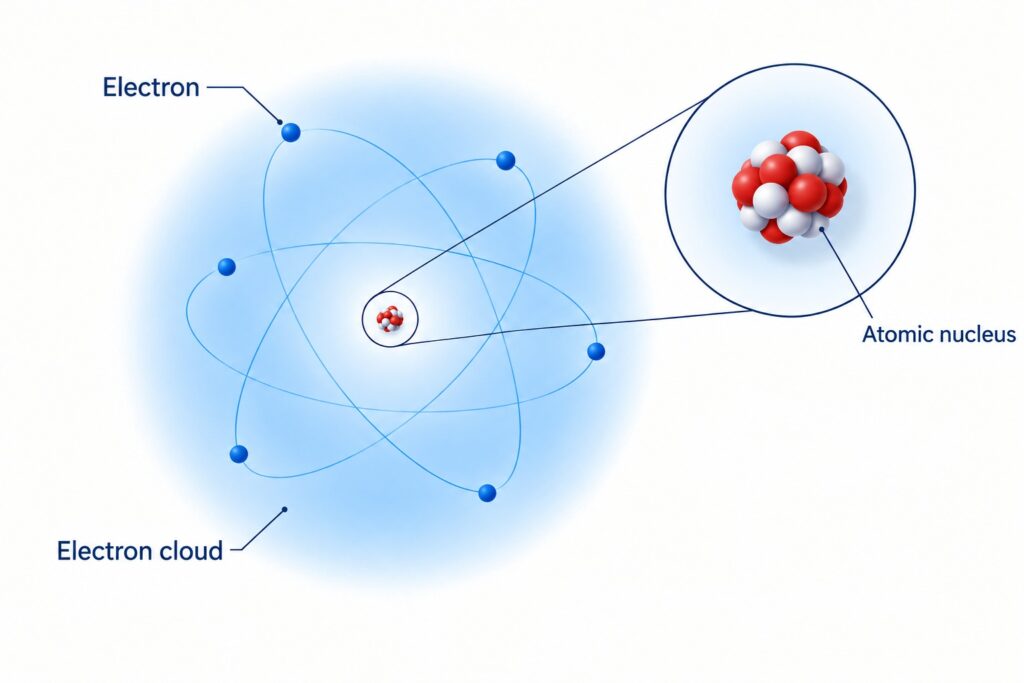
What is particularly interesting is that the atomic nucleus contains almost all of an atom’s mass, while electrons have an extremely small mass – only about 1/1836 that of a proton in the atomic nucleus. To put this into perspective: if a 90-kilogram adult represented the proton, its electronic counterpart would weigh about as much as a small chicken egg (around 50 grams).
Between the atomic nucleus and the electrons, as well as beyond them (in the empty space outside the electron cloud), there is a vast vacuum that is free of matter. If an atom were as large as a football stadium, its nucleus would be only about the size of a pea. The overwhelming majority of the stadium would correspond to vacuum. In other words, an extremely small amount of matter occupies a vast amount of space, yet that space is filled with energy and information. The proportions can be illustrated roughly as follows: only about 0.000000001% of the volume of space is occupied by matter, while the remaining 99.999999999% is vacuum. Atoms are therefore composed almost entirely of empty space.
Albert Einstein described the close relationship between energy and mass in his famous formula E = mc². It expresses the equivalence of energy (E) and mass (m) and shows that mass can be converted into energy – and energy into mass.
This very principle becomes visible in modern particle accelerators. There, physicists collide pure energy in the form of light particles (photons) with one another. Out of this pure energy, real, measurable particles with mass can suddenly emerge in empty space: energy is transformed into mass.
So, what is the true nature of matter? Matter is condensed light – a form of bound or concentrated energy. This means that at our core, we are made of energy, just like everything around us. “Matter” is therefore simply the form in which this energy appears on our perceptual level – essentially, the visible manifestation of energy.
Matter as a Play of Light
We can imagine it like a light projector: only through the light do the images appear on the screen that we see. In a similar way, matter is the visible “image” that arises from invisible energy fields – a projection of energy into the physical world.
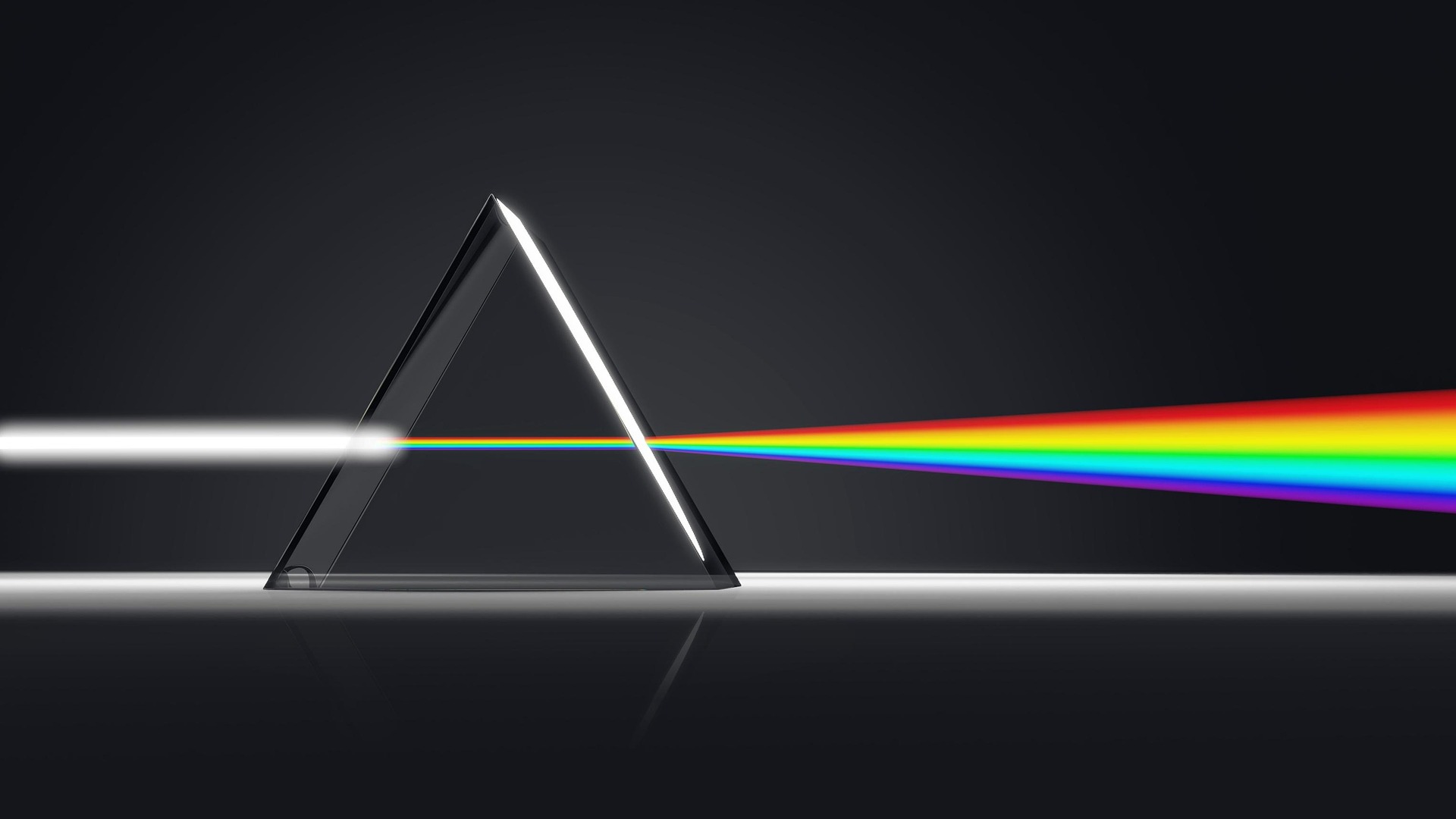
Or like a prism: white light, representing pure energy, is split into its colors as it passes through the prism – symbolizing our body. Just as the light becomes visible as a colorful spectrum, energy unfolds in the material world into countless forms and appearances. The prism shows us that everything we perceive as colorful and diverse is, in truth, an expression of a single source – light, energy itself.
We could therefore say: matter relates to energy as an image relates to its light source. Without light, there is no image – and without energy, there is no matter. What we perceive as solid and tangible is ultimately the action of energy in space: a luminous reflection on the screen of our perception.
Perceptible Energy
If matter is essentially made of energy and empty space, how is it that we can touch and hold things?
The reason lies in the invisible forces between the smallest particles. What we feel when we touch something is the effect of electromagnetic forces between the negatively charged electrons in our skin and those of the object we touch. Like electric charges repel each other – this repulsion prevents atoms from passing through one another. They maintain a distance, and it is precisely this resistance that we perceive as “solidity”. We can imagine this repulsion like with magnets: if you hold two magnets with the same poles together, they repel each other. Something similar happens with electrons, only on an atomic scale.
Additionally, a principle of quantum physics (the Pauli exclusion principle) prevents two electrons from having the same values for all four quantum numbers. Each electron must therefore occupy a unique quantum state; the states cannot completely overlap. This also ensures that matter remains “impenetrable” to us.
When holding an object, these forces continue to act, while at the same time the muscular force opposing gravity keeps the object stable in our hand. It is only this interplay that allows us to truly grasp things.
The repulsion of electrons and the Pauli principle explain why we can feel matter at all. How an object feels – whether soft, hard, rough, or smooth – depends on the internal structure of the material. In a plant, atoms, chemical bonds, and physical structures are arranged differently than in a stone. The strength of the bonds determines how firmly the atoms are connected: very tightly in a stone, more loosely and flexibly in a plant. A hard, densely packed crystal structure results in a different distribution of forces between atoms than soft, water-rich plant cells. Our sense of touch perceives these subtle differences, and the brain translates them into tactile sensations.
Cells, stones, and plants are real structures that we can see, touch, and measure. They are made of atoms, which combine into molecules and then assemble into ordered structures. Upon closer inspection, however, there are no solid particles in the classical sense within atoms. Electrons, protons, neutrons, and the forces between them arise from invisible quantum fields, whose energy states shape the visible world. Everything we perceive is ultimately a manifestation of energy in motion.
Stage of Consciousness
Speaking of perception, let’s take a step further: have you ever wondered whether the world you see, smell, hear, or feel really exists as it appears? Perhaps our reality is more like a play – a stage on which we experience ourselves.
Physicist and consciousness researcher Thomas Campbell describes this idea in his “Big TOE (Big Theory of Everything)”: on this stage, our bodies are the avatars – virtual characters – while our consciousness is the player pulling the strings behind the scenes. “Virtual” in this context does not mean digital, but refers to a representational form of consciousness: the bodies are the visible manifestation of what exists on a deeper, invisible level: energy and information. Our brain functions like a receiver. It consists of billions of neurons that take in signals from the environment, process them, and translate them into patterns. Measurable electromagnetic fields arise from this activity, reflecting the neurons’ activity. From these patterns, the brain constructs the world we consciously experience – our waking consciousness.
Dreams
Our dreams are like little side missions within this simulation. Dream research shows that every person dreams every night – even if we do not always remember these dreams upon waking. In shamanic and other spiritual traditions, dreams are also considered important for inner development.
In the dream state, experiential spaces and realms open up that are not accessible in waking consciousness: other worlds, realities or dimensions, and otherworldly spheres or planes where physical laws such as space and time appear flexible or are completely suspended. We go through scenarios, explore possibilities, and feel emotions with a unique intensity. In this way, we process not only what we experienced during the day. Dreams can also reveal perspectives and messages that remain hidden in everyday life. Trauma, too, is processed through dreams.
In this game, all levels – our avatars, waking consciousness, dreams, all perspectives – are connected to the same source of consciousness. A single source experiences itself through countless lives, from many viewpoints simultaneously, and in this way gathers experience, insight, and growth.

Duality
Duality – light and shadow, joy and pain, good and evil, life and death – is a central principle of our experiential world. We cannot experience one without the other, because our perception always works through comparison: joy is only felt because we also know pain; light appears only because there is darkness; life gains meaning because we are aware of death. The opposites define each other and make our experiences consciously perceivable. Alongside this, there is the tension within a shared frame of reference: polarity. Here, opposites are understood as the respective extremes of a continuous scale: black and white as the endpoints of a spectrum of brightness, warm and cold as the poles of temperature, active and passive as the poles of human action. But what is the purpose of it all?
Near-Death
Near-death experiences provide valuable insights into this. Dutch cardiologist Pim van Lommel studied over 300 people who were clinically dead and then revived. Although much of it is indescribable and difficult to put into words, some core elements emerge: Many reported a detachment from the body, an expanded consciousness, a life review from all perspectives, deep knowledge and wisdom, as well as an overwhelming sense of unity, absolute acceptance, and pure, unconditional love. In this other dimension, there is neither time nor distance, no matter, and no distinction between good and evil, life and death, or past, present, and future. Everything is present simultaneously – in the “eternal now”.
Van Lommel concludes from this that consciousness can exist independently of the physical brain, and that the physical world is only one level of experience. His study was published in 2001 in the prestigious medical journal The Lancet and played a significant role in establishing near-death experiences as a serious field of research within the medical context.
Reincarnation
Reincarnation fits seamlessly into this picture, even though much of it remains speculative and may never be scientifically provable: the rebirth of one or more aspects of consciousness or the soul (incarnation means that the soul enters the flesh, that is, the body). Death ends the avatar, but the timeless, unlimited, all-encompassing consciousness remains. A new avatar opens up new perspectives and experiences, while everything we learn and everything that happens flows back into the meta-consciousness.
The meta-consciousness is a collective field of memories, experiences, thoughts, and feelings, nourished by all people. Everyone is more or less consciously connected to this field and can access it through various means – for example, through dreams. In this field, neither time nor space exists: everything is present simultaneously, always here and now, and everything is preserved on a mental level, nothing is lost.
Visible – Invisible
Researchers like Thomas Campbell and Pim van Lommel suggest that the world as we know it is only one of several possible worlds or dimensions. What we perceive with our senses in waking consciousness is only a part, not the complete picture of reality. The true reality – the truth, so to speak – is not accessible to us in the physical, material world.
Our eyes already make this clear: they can perceive only a tiny portion of the electromagnetic spectrum – the so-called visible light, with wavelengths between roughly 380 and 750 nanometers. Everything outside this range is invisible to us: infrared and X-rays, ultraviolet light, radio waves and microwaves, Wi-Fi and mobile phone radiation, gamma rays. Many other things also escape our perception: magnetic and electric fields, sound frequencies that are too high or too low for our hearing, or quantum phenomena that are too small and too fast to be observed directly. According to some quantum physicists, consciousness itself plays a crucial role in whether and how we perceive reality – for a quantum object must be observed in order to assume a specific state.
Subjective – Objective
When we move through the world as avatars, it becomes clear that our perception is fundamentally subjective. Colors, sounds, temperature, or pain are not the things themselves but interpretations created by our consciousness. Even if there is an objective reality “out there”, we always experience it only through the lens of our senses, our body, and our past experiences.
How, then, can it be that we all seem to perceive the same reality – a kind of objective reality? Could it be that our individual realities are intertwined and harmonized on a higher level through an all-encompassing, unified consciousness? Perhaps we do experience the world subjectively, but in a dimension of consciousness in which everything is interconnected and part of a greater whole, our perceptions flow together in a harmonious way.
Feel the Journey
To feel the journey means living consciously: accepting life in its transience, not clinging to things, refraining from judgment, overcoming separation, and seeking what unites us – and to understand ourselves as players, mentors, and parts of the infinite whole.
The duality and challenges of life serve to enable consciousness to learn, grow, fully experience itself, gain insight, and transform from all perspectives.
This message is not new – what is interesting here is the analogy to age-old myths that share a certain basic structure, known as the monomyth or hero’s journey. This recurring narrative pattern can be found across many cultures and eras: a hero leaves the familiar world, faces trials, gains insights or powers, and finally returns transformed.
Every joy, every pain, every encounter, every incarnation – everything serves the journey of consciousness, which ultimately returns to unconditional love and transforms duality into unity.
Leave a Reply