



Feeling

Feeling, Sharing, Understanding
Travel not only brings us to new places, but often also closer to ourselves. We encounter different cultures, languages, mentalities, traditions, and ways of life, and we come to realize how important our way of communicating is. Above all, the ability to feel – in all its facets – plays a central role while traveling.
But what does it actually mean to feel? Feeling goes far beyond merely touching, being touched, or sensing certain vibrations. It is not only perception through the skin, but also includes our emotions. It’s a vital way of perceiving the world around us.
Whether through the sense of touch, physical sensations, or emotional perceptions, feeling is a key to experience. It helps us recognize not only whether something is pleasant or uncomfortable, but also how we assess ourselves and our surroundings. Especially while traveling, these impressions become particularly intense. Unfamiliar places, the climate, a different sense of time, unusual food, or strange sounds – all of these challenge our senses and our inner balance.
Over the course of our travels, we learned to speak up when something made us uncomfortable and to ask questions when we did not understand something. As the saying goes: only those who speak up can be helped – both at home and abroad.
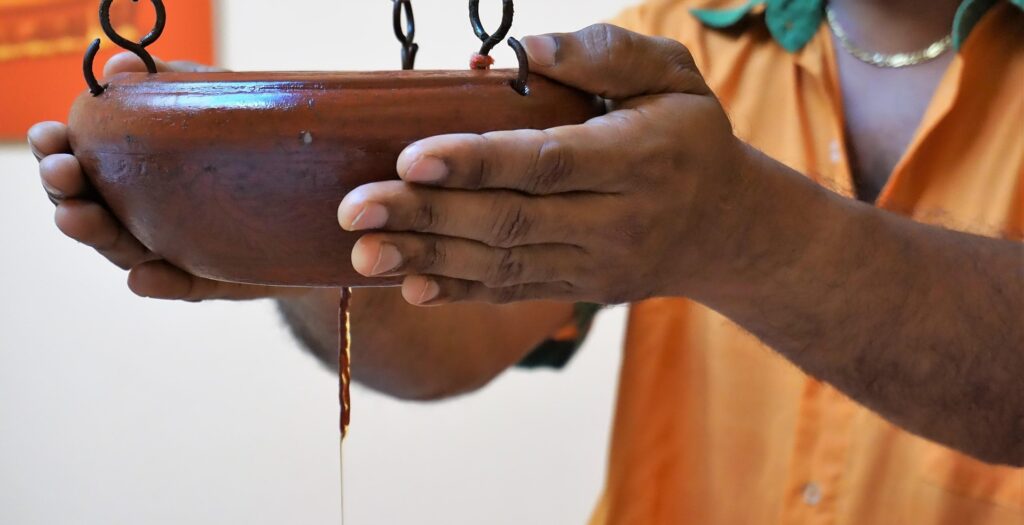
When we use a service – for example, a massage – and notice that something feels irritating or off, it’s worth speaking up. Whether it’s the generous use of oil, unfamiliar touch, a ticking clock, or an uncomfortably cold fan: it often makes a world of difference to express ourselves politely and directly on the spot, rather than quietly getting annoyed and later venting our frustration online in the form of a bad review.
Often, a smile and a simple “no thank you” or “less” are enough. And if there’s no common language, a few gestures usually do the trick. That way, people have a chance to make things more comfortable or explain the situation, because many misunderstandings are simply due to a lack of awareness.
Especially in countries with different cultural practices, it’s important not to judge too quickly. What might feel unfamiliar to us – such as the inclusion of the chest in an Ayurvedic massage or heavily oiled hair – is often part of a long-standing tradition. Once we understand that, we can express our preferences accordingly: less oil, skipping the chest area or the hair. So far, that has always worked well.
Unlike in many Western countries, raising your voice in Asian cultures often has the opposite effect – it gets you nowhere. We once witnessed a group of tourists loudly complaining about a delayed ferry. The more they shouted, the more indifferent the woman at the counter seemed. In the end, they had wasted an incredible amount of energy instead of trying to find a constructive solution together.
On another occasion, we overheard foreign guests loudly complaining to the owner of their accommodation about the macaques in the area. The monkeys had stolen their sweets, which had been left out in the open on the terrace. But what was the owner supposed to do – set up a monkey-free zone? Some wishes are simply impossible to fulfill.
It’s important to remember that subjective online reviews – especially those written in a moment of frustration or out of misunderstanding – can seriously harm self-employed individuals and small businesses. A negative review is unfair if it’s made in general terms, without explanation, and if locals weren’t given the chance to address the issue beforehand. Small businesses grow slowly but steadily, and every review – whether positive or negative – has a significant impact on them.
Communication can definitely improve coexistence among all living beings, even if it “only” encourages reflection. Awareness is often the first step toward change. Many people, for example, are simply unaware that certain behaviors – such as using a phone flashlight on sea turtle nesting beaches – can disturb or affect animals. Often, it is merely a lack of awareness about the impact seemingly small actions can have. When such things are addressed calmly, respectfully, and kindly, they can sometimes lead to an immediate change in perspective. And often, that awareness stays with people in the long term, making consideration for others feel more natural for everyone.
Every misunderstanding and moment of ignorance also holds a chance for better understanding – if we feel it, speak about it, and try to understand. Traveling teaches us that mindful feeling and open communication go hand in hand. Time and again, it shows us that the path to connection leads through kind words, sensitivity, and a bit of courage to start a conversation.
Choosing Feeling Over Judgment
When we travel, we gather impressions – visual, auditory, culinary. Yet we often overlook perhaps our most important sense: feeling. It’s not just the sense of touch with which we physically contact surfaces. Feeling also means sensing, perceiving, and understanding. It includes both physical reactions and emotional responses – empathy, curiosity, irritation, or rejection.
Especially when traveling, we experience how much feeling influences our perception and how much our own judgment depends on it. A lack of understanding and sensitivity toward local circumstances can quickly lead to resentment.
One example of this is entrance fees for national parks or museums in poorer countries. Many tourists get upset that locals only have to pay a symbolic amount, while they themselves are charged many times more. Quickly, accusations of “rip-off” arise, and negative reviews often follow. But when you empathize instead of just calculating, you see the context: In countries like Sri Lanka, the average monthly income is around 270 euros, and the legal minimum wage is about 84 euros. A local once told us that he earns the equivalent of 7 euros a day – for his whole family (wife, two children, grandmother).
In light of this, an entrance fee of 25 euros for a national park – which many locals can’t even afford for 1 euro – takes on a very different meaning. Especially since these fees also help regulate visitor numbers and protect nature. Of course, excessive prices should be questioned critically, so it’s important to research the usual and official fees beforehand. But blanket judgments and snap reviews don’t help anyone – they tend to divide us instead. In general, we do well to show interest in the people, their way of life, and the local challenges they face. It can help put our own perspective into context.
This becomes clear in another way as well: We, who come from so-called industrialized countries, are often seen as wealthy, privileged, and modern. But how much are we really in touch with ourselves? Our world is digitalized and efficient, but also isolating. People increasingly feel alienated, suffering from stress, loneliness, and inner emptiness. While in many poorer countries, despite difficult living conditions, people appear connected – greeting both friends and strangers with a smile, talking and laughing together – what often seems to be missing here is exactly that sense of connection.
Feeling also means pausing for a moment, opening ourselves to other perspectives and ways of life, and not treating our own standards as absolute. It helps us recognize what truly matters.
Traveling is an invitation to sharpen our senses, connect with ourselves, and approach others with openness, respect, and compassion. It is also an inner process, because every outer journey is an inner journey as well. Those who truly feel and empathize begin to understand – and judge less quickly.
Leave a Reply